
The Problem with IX Marks
And Their Social Justice Compromises

Every now and then someone asks me about a particular parachurch ministry and whether it is good or bad, usually with the assumption that “bad” means the ministry caved to the social justice movement when it mattered most and never repented or retracted. There are several figures like Rosaria Butterfield, Willy Rice, and Josh Howerton who publicly signaled their regret and have actively sought to undo whatever negative impact their previous statements and positions may have had. But this is a rare phenomenon, and even more rare for institutional spokesmen.
This presents a dilemma. Are Southeastern Baptist Theological Seminary or Grove City College trusted institutions? They each received more public pressure than many evangelical organizations to cease their obvious and proven associations with social justice teaching, yet their reactions were less than receptive. I was involved, sometimes initiating, many of these public exposure attempts to little avail other than making Christians aware of the problem so they would put their guards up. (Of course, there were organizations that did teeter and come back. Liberty University is one of those stories, and perhaps someday I will be able to tell that story in more detail).
I always found it frustrating when an organization tried to reverse course but refused to do it publicly, as if it would reveal that they are run by humans who get things wrong at times. Who would have known? Al Mohler has changed his positions several times on several issues, including same sex attraction, the Me Too movement, and whether women who seek abortions should be punished, without acknowledging that he has changed his thinking at all. Cru just recently updated their teaching on same sex attraction without acknowledging that they had incorrectly trained their own staff with the opposite thinking.
Still, I think it is important for Christians to see these course corrections as positive. Paul was able to commend the veracity and importance of the gospel message even when it came from the lips of those seeking to usurp him. However, Paul still highlighted their ill motives. His endorsement only went as far as the truth of their message and no further. There is no reason to trust men who commit egregious errors and fail to acknowledge them. It reveals an unwillingness to face their own ill motive of pride.
CRT, BLM, and Anti-Racism
This brings me to IX Marks, a parachurch ministry that focusses on ecclesiology but more than dabbled in social justice from around 2010 to 2021. I attempted to explain and refute many of their teachings toward the end of this period. There has been some acknowledgement of imbalance but not what one would expect for repentant leaders. I will walk through some of the examples of compromise that still remains on the IX Marks website.
Starting around 2010, IX Marks started publishing material that suggested white evangelicals were lacking sanctification in their conception of race and treatment of ethnic minorities. Thabiti Anyabwile suggested that the gospel itself included a certain view on race (that it was a social construct) and that white evangelicals lacked the sanctification to realize this truth, even though ethnic minorities were engaging with it. Anyabwile used words like “idolatry” and “segregated” to describe the church’s failure to bring about “racial unity.” In his mind, the church was the answer to the racial divide but it unfortunately, had “a ways to go.” This drove a hunger for Christians to find what was allegedly so lacking in our churches and why they were under sinful thinking. Organizations like IX Marks were positioned to answer this demand with the tools a syncretic mixture of scripture and social justice afforded them.
In no time, IX Marks was publishing articles on how to diversify churches such as “Five Steps for Racial Reconciliation on Sunday at 11 a.m.,” “Pastoring a Multi-Ethnic Church,” and a “Pastors and Theologians Forum on Race.” The forum is particularly interesting because it reveals how early ideas consistent with Critical Race Theory were being introduced into the church.
IX Marks published this article on March 1, 2010, but most Americans would not become familiar with the language it used until 2020. Christian leaders like J. D. Greear, Juan Sanchez, Kevin Smith, and others told Reformed evangelicals that racism was a normal reality in the American church. This was largely because whites enjoyed privilege, failed to see racism, and lacked black perspectives that could help them understand it. In order to be true to the Gospel, white people should diversify their leadership in churches and seminaries and seek to see things from minority perspectives.
I believe one of the things that helped shield IX Marks from criticism, especially in these early days, was the fact that they continued to oppose theological liberalism, which has often been associated with political liberalism, and for good reason. For example, Russell Moore’s piece “Social Gospel Redux?” took aim at Walter Rauschenbusch and the Emergent Church for denying the place and power of individual salvation. As I have often said, the Social Gospel critique did not start out as an attempt to replace the gospel, but to expand it into corporate structures. Rauschenbusch claimed:
The social gospel is the old message of salvation, but enlarged and intensified. The individualistic gospel has taught us to see the sinfulness of every human heart and has inspired us with faith in the willingness and power of God to save every soul that comes to him (Rauschenbusch, A Theology for the Social Gospel, 5).
The social justice subversives in Reformed evangelicalism made a similar move by claiming they possessed the balance that both Social Gospel adherents and Fundamentalists, who focused more on personal conversions, lacked. But all they were really doing was claiming the same balance that many Social Gospel advocates and Liberation Theology proponents already claimed for themselves, while packaging their salvific corporate element in more racially charged and less economically charged language.
This is seen in a 2014 IX Marks article by Steven Harris that seeks to correct the problems with Liberation Theology, including its over realized eschatology and its framing of sin according to social dynamics instead of as a violation of God’s law, but also seeks to legitimize its “fair critique of some in the evangelical community by exposing what can only be regarded as indifference toward injustice.” In Harris’s piece, the gospel was not reduceable to anti racism, but anti racism was part of gospel ministry, as was opposing “institutional and corporate sin.” This was allegedly what many of our forebears, who sat on the bench during the Civil Rights Movement, failed to see—that it was their duty to support racial social equality if they were consistent Christians. Where orthodox believing Christians had apparently failed, liberation theologians and the New Left had succeeded.
I saw this attitude, that liberal Christians were essentially wrong theologically but right on social issues, grow around this time in Reformed evangelicalism from where I sat at Southeastern Baptist Theological Seminary. It eventually developed into a general posture that there was much to be gleaned not just from the Christian Left, but also from Leftists in general. The supposed “balanced” approach was that Christianity transcended politics. Some issues, like abortion and sexuality, were seen as more in line with orthodox teaching, while issues like systemic racism, climate change, and the Me Too movement were seen as more in line with the Left.
In fact, on right leaning issues, IX Marks seemed to use a much softer voice. Jonathan Leeman, the current president of IX Marks, made sure to tell readers in his article that he was not encouraging them “to be a cultural warrior, or to raise up a church of cultural warriors” on the issue of same sex marriage. This was less than a year before Obergefell v. Hodges, when we could really have used some cultural warriors. The same year, Russell Moore practically celebrated the demise of “nominal, cultural Christianity” in the face of secularism, in the hope that the church’s lost influence would lead to its purification. IX Marks was sending a message that it was time for the church to work for social change on institutional racism while simultaneously resigning the culture to slide on sexuality.
In 2015, the anti-racist push intensified. In the aftermath of the Obergefell decision, IX Marks published sixteen consecutive articles on race, racism, and racial diversity, while offering only a single article on homosexuality. Rather than preparing Christians for the lawsuits that were coming their way, Jonathan Leeman wrote a piece with the question in its title, “Should Christians ‘Disown’ Gay Sons and Daughters?” Spoiler alert: they should not.
To their credit, almost a year after the Supreme Court decision, IX Marks did publish a sample marriage policy that, among other things, was intended to help church’s navigate the “ongoing pressure for the church to participate in homosexual weddings.” But it was still more than a little odd for a ministry so focused on ecclesiology to fail to anticipate the threat from Obergefell while pouring so much energy into narratives adjacent to Black Lives Matter. And, they truly were embracing those narratives long before 2020.
With headlines like: “Why White Churches Are Hard for Black People,” “Being Asian American in a White Church,” and “Don’t Be Color-Blind at Church,” Christians were taught that if they fail to see race they are beginning to “erase” people, that white Christians “need minority brothers and sisters to help [them] be conscious of a world outside of [their] own little sheltered experience,” that Christians “must do a better job living out the gospel of racial-reconciliation,” that black females are seen as “second class” in white churches where they are reportedly not asked out on dates, and that pastors should vocally acknowledge racial injustice, such as in the cases of Eric Garner and Michael Brown.
The next year Mark Dever, the founder and then-president of IX Marks tweeted “#BlackLivesMatter seems to be a wonderfully pro-life statement as well.” The current president, Jonathan Leeman tweeted: “#BlackLives Matter: a glorious, life-affirming, and succinctly stated theological truth!”


Unsurprisingly, the anti racism articles kept coming. Pastor Brian Davis told Christians that the shootings of Alton Sterling and Philando Castile were motivated by racism. In an emotive and somewhat confusing article, as many of the pieces on the topic from IX Marks are, Davis told pastors they did not need an “expert black person” to understand the “cultural crisis over race,” even as he invited them to the “Just Gospel” conference, which he said would be “led by men who are theologically precise minorities.” Leading up to 2020, there were regular reminders that American Christians lived in an unfair country, were often complicit in racist structures, and needed to active in resisting these forces.
Shai Linne echoed the conclusion of the Obama Administration’s Report on Baltimore Police Department alleged racism. Mika Edmonson somehow connected Martin Luther’s opposition to indulgences and support for charity to anti-racism. Mark Vroegop took his church on a Civil Right’s field trip to learn about unity in Christ. Books like White Awake and Divided by Faith were recommended as useful tools for Christian teaching. Then 2020 came.
Five days after George Floyd’s death, IX Marks published an article by Michael Lawrence that made things clear. First, silence was not an option. Second, George Floyd was unjustly killed and the anger minority communities felt was justified. The weakness in IX Marks’ approach was beginning to show. Anything substantive they offered regarding these divides was framed from the Left and tended to be theologically shallow or difficult to apply.
An article that August from a seasoned pastor, intended to help other pastors navigate the fallout surrounding George Floyd’s death, once again diagnosed the issue as a lack of racial unity. The piece invoked Scripture, pointing to how Gentiles did not need to become Jewish proselytes to be part of the church’s covenant community, and how God intended for Israel to remain united and reject idolatry. The author concluded, “I confess: the elders of my church are still struggling with what to do next.” This desire for unity amidst increasing political polarization saw a shift in how IX Marks approached divisive social matters with racial components.
It would have been nice if they highlighted more directly related passages, addressing matters such as due process, prohibitions against the kind of looting that had by then become commonplace, and unequal weights and measures, but they were not brought into the discussion in any significant way. Instead, articles calling for charity, restraint, and more general calls for unity without a hard social justice bent started to emerge. When divisions along racial lines were handled after this point, social justice theories were also blamed for stoking divisions. This is the current default posture of IX Marks on anti racism, with no acknowledgement of how it differs from its posture over the previous decade. What was once clear and necessary to highlight is now treated as complex, and caution is advised.
Marriage, Singleness, and Sexuality
I should note that during this time, IX Marks also veered left, by evangelical standards, on questions of homosexual orientation and the importance of marriage. To be clear, they obviously continued to exalt marriage and motherhood, but therein lies the tension. I do not want to get too far into the weeds here, since their endorsement of ideas adjacent to Critical Race Theory was more significant. But it is still important, and those who consumed their material should be aware of some of the anti biblical assumptions embedded within these pieces.
One of the frustrating things about evangelical institutions during this period was that they tended less toward offering guidance for addressing falling marriage rates and the fertility crisis and more toward accommodating these forces by shepherding the outcomes of our sexual crisis. To be sure, there have always been single people, and they serve the church through their spiritual gifts. They need shepherding. But the suggestion that the church or spiritual identity could somehow substitute for marriage by solving problems like loneliness turned the natural order on its head. In one article, Mary Wilson asked questions like:
“Why does our culture exalt marriage over singleness?” When God says, ‘It is not good that the man should be alone,’ does that pertain only to marriage? Does it also pertain to men and women partnering in gospel ministry?”
These are just questions, but they rest on dysfunctional assumptions rooted in an anti creation posture. The Left has long treated traditional sexual arrangements as merely culturally derived rather than grounded in a divine order, and here a theological conservative publication is carrying water for that view.
Sean Demars wanted to normalize singleness by doing things like reminding single church members that “they are members of the same [spiritual] family.” Ed Shaw promoted the idea that churches should see intimacy as more closely associated with friendship and, in doing so, lessen the “power of sexual temptation” and provide “honesty and accountability” for same sex attracted people like himself as they pursue what he described as “true intimacy” in friendship. Tom Schreiner did not want Christians to assume “that everyone should get married or encourage everyone to get married.” He concluded: “We need to reclaim the beauty of singleness as it is taught in the scriptures.”
This magnifying glass on the existence of singles, and the repeated emphasis on just how normal it is to be single, frankly made me feel awkward just reading about it because of how un normal the overemphasis makes it seem. I am sure that pastoring a church in a blue urban area comes with a unique overrepresentation of single people, but how healthy is it to spiritualize their legitimate desires for marriage and family rather than approach the issue by acknowledging it as a legitimate trial and helping to walk someone through it and alleviate it if possible?
It makes me want to cry when I read something like, “My true identity is not in how desirable men might find me or in whether I am pursued for marriage, but that I have already been ultimately pursued and my greatest needs are met in God.” There is some truth here, but it is also true that God designed people for marriage and family. It is entirely appropriate to acknowledge the hole one senses when those things are not manifesting themselves.
However, where this goes off the rails is when it is applied to same sex attraction. In one article, Sam Allberry asked, “How can churches do a good job of integrating people who experience strong same sex attraction into the life and body of the church?” The answer centered largely on de emphasizing sex and marriage while emphasizing celibacy and singleness, with the assumption that “the person with SSA may feel it is less realistic that they will get married and so be looking at long term singleness.” Obviously, no other sinful proclivity would be treated in this way. Churches in Reformed evangelical circles were not being asked how to integrate anti Jewish ideologues or anything similar, yet they were pressured on this point.
IX Marks also recommended Ed Shaw’s Same-Sex Attraction and the Church: The Surprising Plausibility of the Celibate Life, and hosted a positive review of Caleb Kaltenbach’s Messy Grace: How a Pastor with Gay Parents Learned to Love Others Without Sacrificing Conviction, both of which legitimize a kind of celibate homosexual orientation as not sinful.
It is very good that IX Marks held the line on complementarianism against feminism, even if the grounding for distinct roles was not especially strong. Rather than entertaining ideas that ground gender roles in the Trinity or abstract intention of God it would have been better to argue more directly from creation, emphasizing the differences that inevitably manifest in the world God made. That was, and still is, what the moment calls for, because that is what is directly under attack.
It is not even so much “expressive individualism,” which IX Marks published nine articles about, including blaming it for the confusion surrounding gender and sexuality. Individuals who want to step outside of God’s order on these matters inevitably seek social confirmation, legitimacy, and legal recognition, even though they are, as individuals, relatively free to act as they choose. An application of Romans 1 suggests that the feminist and LGBTQ+ movements pastors actually encounter are, at their root, driven by opposition to God and His design. Nonetheless, this remains an area where, all things considered, IX Marks did better than many other neo evangelical institutions and did include arguments from creation, even if they could have emphasized this more. The real test for IX Marks though, as an ecclesiology ministry, was how they handled Covid.
Covid, Politics, and Abortion
IX Marks tends toward the idea that the church transcends politics until there is a justice issue of some kind the church must mobilize for. During the lockdowns of 2020, Jonathan Leeman invited others to participate with him in a protest to “change the nation’s culture, police culture, and even the church’s culture—that all would affirm the God-imaging and God-given glory of black lives.” Yet, this was at the same time that Capitol Hill Baptist Church shut down to comply with lockdown measures and justified it on the IX Marks website.
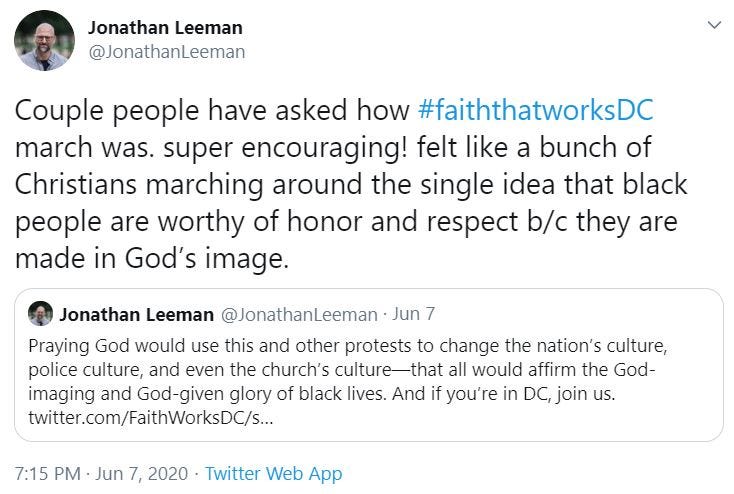
When Jonathan Leeman publicly questioned John MacArthur’s earlier reopening of Grace Community Church in Sun Valley, California, sides quickly formed. Leeman compared Covid lockdowns to measures such as World War Two blackouts and zoning restrictions, which, of course, did not prevent Christians from gathering, especially over the long term. One of the most startling lines in Leeman’s article is a question he asked:
The politics of LGBT tells me our churches may have more occasions to defy government requirements in years to come. Do we want to spend down our capital on pandemics?
We already surveyed how IX Marks treated Obergefell when it mattered most. This calculating mentality reveals a strategy to challenge future government overreach by submitting to current orders.
With over twenty Covid related articles, IX Marks gave instruction and encouragement on things like prayer, connection, and advise on reopening when legally permissible. Initially, they adopted the popular application of Romans 13 to encourage churches to take mandate compliance seriously. Yet, by late November they opened the door for potential legal challenges to unlawful orders and undermined the intentions and effectiveness of continuing mandates. That article stated:
Romans 13:1–7, 1 Peter 2:13–17, and other passages make submission to governing officials the biblical norm, and noncompliance the exception. Nevertheless, there are at least two instances in which noncompliance with a law or order is biblically justified: (1) when complying with a law or order would be contrary to the will of God as revealed in Scripture, and (2) when the law or order is itself legally invalid.
Once again, the decisive moment had passed them by, as it had on same sex marriage and the Black Lives Matter movement. When it mattered most, IX Marks showed a consistent tendency, within naturally politically conservative evangelicalism, to push the needle toward the Left. For example, today IX Marks uses harder language toward the LGBTQ+ movement. Jonathan Leeman said it was “neo-paganism” and called Christians to speak publicly against it. This strong language is good, but it is also late.
One of the more interesting aspects of all of this is the lack of self reflection IX Marks seemed to have regarding what it was doing politically. They did not appear to recognize they were carrying water for a particular political side. Dever, in particular, tried to signal neutrality. After Trump won in 2016, he published “Neither a Republican Nor a Democratic Church.” In it, he argued that black people experienced racism in ways white people did not understand, and then rather awkwardly pivoted to express political neutrality. He wrote:
I think it’s actually our best gospel-strategy to grow as Christians, and to reach Capitol Hill and this District to work hard against identifying our church with opposition to either party.
This article, which was taken from one of Mark Dever’s sermons, neatly captures the general posture: frame the situation in terms generally favorable to Democrats and then claim political neutrality. Some have pointed to Dever’s alleged Democratic Party membership in an attempt to make sense of this. Maybe it does, maybe it does not.
I remember being at the Supreme Court building in October 2020 and meeting a young man who was protesting Supreme Court Justice Amy Coney Barrett, claiming she was racist and that racism was a more important pro life issue than abortion. He described himself as a political conservative, was studying for the ministry, and attended Mark Dever’s church, Capitol Hill Baptist Church. When I asked him about his position on abortion, he told me he was “pro choice.” He also planned to vote for Joe Biden.
This man’s conclusions are his own and do not reflect Mark Dever’s views, especially since Dever is avowedly pro life. However, I can see how a young man like this might reach such a conclusion if all he had to go on was IX Marks’ public teaching. There is only one article on the website classified as being on abortion, and it was published weeks before my encounter in D.C. In the article, “What Makes a Vote Moral or Immoral? The Ethics of Voting,” Jonathan Leeman clearly condemns Christians who vote for a “pro choice candidate specifically to support abortion,” but he hedges on whether it is sinful to vote for a pro choice candidate, despite a pro life candidate being in the race.
I can appreciate the difficulty Leeman highlights in navigating long term political chess moves, but this is not a difficult decision in a world where real babies’ lives are threatened by short term political decisions. All things are not equal. Pro life Supreme Court appointments, the Mexico City Policy, and defunding Planned Parenthood will either happen or they will not. One party is, at least sometimes imperfectly, devoted to ensuring these measures occur, while the other party is thoroughly committed to making abortion as accessible as possible.
Unfortunately, at a 2018 9 Marks event, Mark Dever, while sitting on a panel with Jonathan Leeman, justified voting for pro‑choice candidates on the grounds that Black Christians made superior political calculations compared to white Christians because they accounted for multiple issues while white Christians focused primarily on abortion. Dever stated:
I think of the things that most separates white Christians and black Christians in America is one-issue voting. I can vote for a candidate who I disagree with on some very important issues—that I don’t think they’re going to get anything done on—but I agree with them on these other issues that are going to help a lot of people. . . I think a lot of our African American brothers and sisters realized like a long time ago, well there are going to be a bunch of different issues that are going to affect us. I think white Christians think this [voting based on pro-life stance] is the only moral way to approach voting.
To Jonathan Leeman’s credit, he recently retracted this on Dever’s behalf. He said in an interview: “I don’t think you should vote for a pro-choice candidate. I think that was wrong. And these days I would say ‘I think you’re sinning by doing that’, at least in most circumstances.” The reason he and Dever went down this path he explained was because they were “trying very much to appeal to both Republicans and Democrats for gospel purposes.”
I do not want to question the root motives of IX Marks, but I do question their judgement. They are quick to opine on issues like January 6, without suspecting the mainstream news narrative may be wrong. But often slow on getting basic issues of public morality correct when it could subject them to condemnation from the Left.
Forgiveness Versus Trust
Here is the bottom line on IX Marks and any organization that went woke to one extent or another and wants to put that behind them: There are no do overs, there is forgiveness, but that does not necessitate trust. If there is little recognition of where someone(s) went off, there is certainly no reason to trust them when similar issues arise in the future. Even with a heartfelt repentance, it takes time to build trust again. 2 Timothy 2:2 makes it clear that “faithful men” are the only kind of men Christ wants leading His church. Unfortunately, IX Marks has put themselves in a Proverbs 25:19 position, which says: “Like a bad tooth and an unsteady foot is confidence in a faithless man in time of trouble.”
There is a market right now for brave and confident leaders, and many, especially online, have little to show from past experience that would earn current trust. This is even more true for those who failed so many cultural tests in such a short period of time. While IX Marks receives much positive feedback for its ecclesiology resources, including guidance on issues such as multi site churches, membership, eldership, and revitalization, I cannot recommend trusting them on social matters for the foreseeable future. It is good they are course-correcting, but that is only the first step in a longer process that may one day reestablish trust.
If you can't trust a person or organization on one thing, then I would say you shouldn't trust them on everything else. You open yourself up to being deceived on those other things where they appear to be correct.
Remember Romans 16:17. All those people and organizations you have named are those we should stay away from.
I appreciate that you and others are calling everything out. But I think it's long been past time to stop giving them the benefit of the doubt anymore.
If they truly repent and seek forgiveness for what they have said, written, or done, then we can open our arms to them and welcome them back.
And if they appear to be going back to causing divisions via their old ways, we kick them to the curb once again.
Rinse and repeat.
There are no gray areas and I'm just tired of people trying to find common ground anymore with those who will just use it to continue to drag people away from what is right and true.
You continue to amaze me with the breadth of the things you draw our attention to, and this article is no exception. But one topic you raise here also deeply burdens me, which is the veneration of singlehood in the church. You can read some of my thoughts here: https://www.touchstonemag.com/archives/article.php?id=31-06-020-v